Sie sind hier: Startseite > Medikamente > Antiandrogene Hormontherapie > GnRH-Agonisten
Antiandrogene Hormontherapie mit GnRH-Agonisten
- Antiandrogene Hormontherapie: Chemische Einteilung, Nebenwirkungen
- Antiandrogene Hormontherapie: Flutamid
- Antiandrogene Hormontherapie: Bicalutamid
- Antiandrogene Hormontherapie: GnRH-Agonisten
- Antiandrogene Hormontherapie: GnRH-Antagonisten
- Hemmer der Testosteronsynthese: Abirateron
- Antiandrogen Enzalutamid
- Antiandrogen Apalutamid
- Antiandrogen Darolutamid
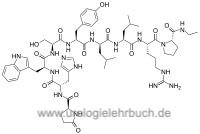
Zusammenfassende Literatur: (Anderson, 2003) (Loblaw u.a., 2004) (Miyamoto u.a., 2004).
GnRH-Agonisten (Präparate):
Buserelin, Goserelin, Histrelin, Leuprorelin, Triptorelin.
Wirkmechanismus der GnRH-Agonisten:
GnRH-Agonist (veraltetes Synonym: LHRH-Agonist), die längere Halbwertszeit verhindert die pulsatile GnRH-Stimulation an der Hypophyse, die negative Rückkopplung überwiegt. Weiterhin werden die GnRH-Rezeptoren herunterreguliert. Als Folge wird eine hypophysäre LH- und FSH-Ausschüttung verhindert, durch die fehlende Stimulation der testikulären Testosteronproduktion sinkt das Serumtestosteron auf Kastrationsniveau (unter 0,5 ng/ml Testosteron).
Indikationen für GnRH-Agonisten:
Fortgeschrittenes Prostatakarzinom, als Alternative zur operativen Kastration. Zur maximalen antiandrogenen Therapie in Kombination mit einem Androgenrezeptorblocker. Siehe Kapitel [Hormontherapie des Prostatakarzinoms].
Pharmakokinetik der GnRH-Agonisten:
GnRH-Agonisten sind subkutane Depotpräparate, welche monatlich oder alle drei Monate verabreicht werden. Es existieren auch Implantate mit jährlicher Applikation (Histrelin).
Nebenwirkungen der GnRH-Agonisten:
Von den Nebenwirkungen der Antiandrogene sind für GnRH-Analoga typisch: Osteoporose, Hitzewallungen, verminderte Libido, Verlust der erektilen Funktion, Störung der Gedächtnisfunktion, körperliche Schwäche, Müdigkeit, Depressionen. Weitere Nebenwirkungen:
- Kurzfristiger Anstieg des Serumtestosterons bei Therapiebeginn, kurzfristige Verstärkung der Symptome des fortgeschrittenen Prostatakarzinoms ist möglich (Knochenschmerzen, Miktionsstörungen).
- Allergien oder Infektionen an der Einstichstelle.
- Fehlende Wirksamkeit, als suffiziente Wirkung wird eine Testosteronkonzentration unter 0,5 ng/ml angenommen (Kastrationsniveau). Hilfreich bei fehlendem Erreichen des Kastrationsniveaus ist ein Präparatwechsel (GnRH-Agonist oder Antagonist), die Orchiektomie oder die zusätzliche Gabe von Androgenrezeptorblocker.
- bei langfristiger Gabe Hodenatrophie, selten Gynäkomastie.
- Fallberichte über Hypophysenadenome
Kontraindikationen der GnRH-Agonisten:
- Nach chirurgischer Kastration
- Allergie und Unverträglichkeit
- Prostatakarzinommetastasen der Wirbel mit Kompression des Rückenmarks: GnRH-Antagonisten oder chirurgische Kastration sind bessere Alternativen.
Dosierung der GnRH-Agonisten:
Bei Therapiebeginn muss zusätzlich für 2 Wochen Flutamid oder Bicalutamid p.o. verabreicht werden, um den initialen Testosteronanstieg zu blocken.
Buserelin:
9,45 mg s.c. alle 3 MonateGoserelin:
10,8 mg s. c. alle 3 MonateHistrelin:
50 mg Implantat s.c. für 12 MonateLeuprorelin:
11,25 mg s. c. alle 3 MonateTriptorelin:
11,25 mg s. c. alle 3 MonatePräparatenamen der GnRH-Agonisten:
Profact (Buserelin). Zoladex (Goserelin). Vantas (Histrelin). Eligard, Enantone und Trenantone (Leuprorelin). Pamorelin (Triptorelin).
| Bicalutamid | suchen | Degarelix |
Sachregistersuche: A B C D E F G H I J K L M N O P Q R S T U V W X Y Z
Literatur Antiandrogene Hormontherapie
Anderson 2003 ANDERSON, J.: The role of antiandrogen monotherapy in the treatment of prostate cancer.In: BJU Int
91 (2003), Nr. 5, S. 455–61.
Choo u.a. 2005 CHOO, R. ; CHANDER, S. ;
DANJOUX, C. ; MORTON, G. ; PEARCE, A. ;
DEBOER, G. ; SZUMACHER, E. ; LOBLAW, A. ;
CHEUNG, P. ; WOO, T.:
How are hemoglobin levels affected by androgen deprivation in
non-metastatic prostate cancer patients?
In: Can J Urol
12 (2005), Nr. 1, S. 2547–52.
Diamond u.a. 2004 DIAMOND, T. H. ; HIGANO,
C. S. ; SMITH, M. R. ; GUISE, T. A. ; SINGER,
F. R.:
Osteoporosis in men with prostate carcinoma receiving
androgen-deprivation therapy: recommendations for diagnosis and therapies.
In: Cancer
100 (2004), Nr. 5, S. 892–9.
Loblaw u.a. 2004 LOBLAW, D. A. ; MENDELSON,
D. S. ; TALCOTT, J. A. ; VIRGO, K. S. ;
SOMERFIELD, M. R. ; BEN-JOSEF, E. ; MIDDLETON,
R. ; PORTERFIELD, H. ; SHARP, S. A. ; SMITH,
T. J. ; TAPLIN, M. E. ; VOGELZANG, N. J. ; WADE,
Jr. ; BENNETT, C. L. ; SCHER, H. I.:
American Society of Clinical Oncology recommendations for the initial
hormonal management of androgen-sensitive metastatic, recurrent, or
progressive prostate cancer.
In: J Clin Oncol
22 (2004), Nr. 14, S. 2927–41.
Loprinzi u.a. 2004 LOPRINZI, C. L. ; BARTON,
D. L. ; CARPENTER, L. A. ; SLOAN, J. A. ; NOVOTNY,
P. J. ; GETTMAN, M. T. ; CHRISTENSEN, B. J.:
Pilot evaluation of paroxetine for treating hot flashes in men.
In: Mayo Clin Proc
79 (2004), Nr. 10, S. 1247–51.
Montgomery u.a. 2005 MONTGOMERY, B. S. ;
BORWELL, J. P. ; HIGGINS, D. M.:
Does needle size matter? Patient experience of luteinising
hormone-releasing hormone analogue injection.
In: Prostate Cancer Prostatic Dis
8 (2005), Nr. 1, S. 66–8.
Miyamoto u.a. 2004 MIYAMOTO, H. ; MESSING,
E. M. ; CHANG, C.:
Androgen deprivation therapy for prostate cancer: current status and
future prospects.
In: Prostate
61 (2004), Nr. 4, S. 332–53.
Smith u.a. 2003 SMITH, M. R. ; EASTHAM, J. ;
GLEASON, D. M. ; SHASHA, D. ; TCHEKMEDYIAN, S. ;
ZINNER, N.:
Randomized controlled trial of zoledronat to prevent bone loss
in men receiving androgen deprivation therapy for nonmetastatic prostate
cancer.
In: J Urol
169 (2003), Nr. 6, S. 2008–12.
Smith u.a. 2004a SMITH, M. R. ;
FALLON, M. A. ; LEE, H. ; FINKELSTEIN, J. S.:
Raloxifene to prevent gonadotropin-releasing hormone agonist-induced
bone loss in men with prostate cancer: a randomized controlled trial.
In: J Clin Endocrinol Metab
89 (2004), Nr. 8, S. 3841–6.
Smith u.a. 2004b SMITH, M. R. ;
GOODE, M. ; ZIETMAN, A. L. ; MCGOVERN, F. J. ;
LEE, H. ; FINKELSTEIN, J. S.:
Bicalutamide monotherapy versus leuprolide monotherapy for prostate
cancer: effects on bone mineral density and body composition.
In: J Clin Oncol
22 (2004), Nr. 13, S. 2546–53.
 English Version: GnRH agonists for advanced prostate cancer